There was initial confusion as to which room had been booked at a Mayfair hotel in London for a small group of SME housebuilders. Howclosely the general manager of the InterContinental in Park Lanestudies the new homes market was not clear, but maybe he was simply surprised by the number: ‘Three you say? I didn’t realise there were that many SMEs left.’
Gallows humour did pepper the conversation round a table brought together by Richard Hemmings, managing director of Quantum Development Finance. But while there was plenty to complain about, if wisdom, innovation and passion could be converted into homes, we’d have got to Labour’s cloud cuckoo land target of 1.5 million before lunch.
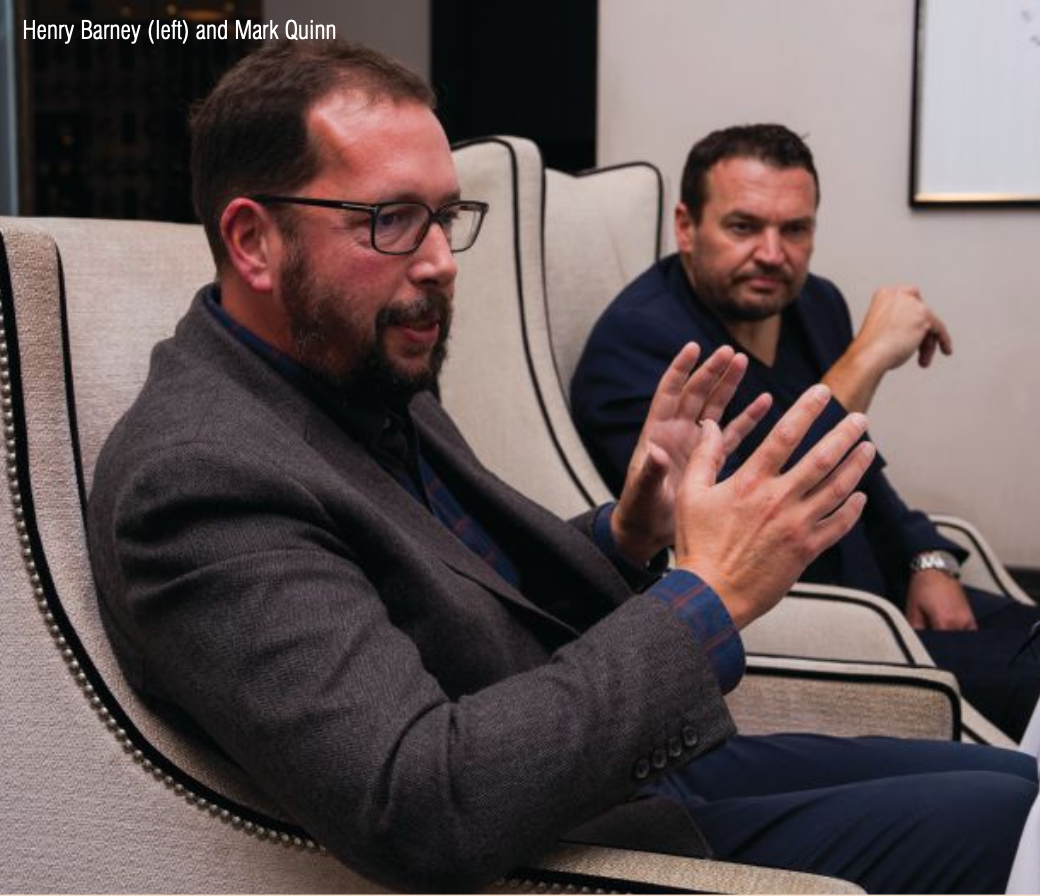
The trio alongside Hemmings were drawn from the counties of Northamptonshire, Wiltshire and Kent, all with horror stories to tell –and, yes, planning was invariably the Hammer House – but SME leaders Henry Barney (left) and Mark Quinn who made you realise just what talent and resolve is out there, if only government, both national and local, could remotely begin to understand the business of housebuilding.
Meet Henry Barney, managing director of Grace Homes, covering the Midlands of Northamptonshire and Leicestershire; Adam Marks, commercial and technical director of Back house, based in Chippenham; and Mark Quinn, chairman of Kent-based Quinn Homes.
Grace Homes currently builds around 50 homes a year; Backhouse, backed by Cheyne Capital, circa 100 properties; and Quinn Homes, approaching 150 per annum, while the Quinn Estates strategic land business has about 3,000 homes in its pipeline, so acutely aware of the volume play, as well as a SME’s field position.
We were meeting against a backdrop of what Richard Hemmings called “the toughest market in 20years” with the bottom of the buying chain in particular strife. Quantum Development Finance focuses onSME house builders, winning business by understanding their clients and redefining what lending should look like compared to the banks with their risk-averse ‘computer says no’ approach to funding and debt provision. Quantum provides bespoke finance, flexibility and, with its in-house investment committee, fast decision making – a true relationship-led lender.
“There will always be an element of risk when lending, which is why trust and personal relationships are so important,” said Quinn.
Certainty for SMEs was key, with at least forewarning of regulation shocks, but also, as working to the tightest margins, the need for, said Marks, “every support lever to be pulled”. But, government, in its ignorance, was putting up barriers not pulling levers, unable to recognise that stunting growth with tax rises, not to mention huge uncertainty as to what the autumn budget might contain, had a direct impact on a house builder’s ability to sell and the viability of its business, however many ‘Build Baby Build’ red caps housing secretary SteveReed signs.
In a rare – maybe only – pat on the back for a politician, Quinn did admit that Reed, despite his contemptuous attitude to farmers during his tenure at DEFRA, had a reputation for getting homes built and, as a former
(L-R) Richard Hemmings, Adam Marks and Rupert Bates leader of Lambeth Council, co-chaired the Vauxhall/Nine Elms/Battersea regeneration board, so perhaps he’ll have the right keys on his belt to unlock housing, as long as he also recognises the value of SMEs, and not just vast capital projects, to make the new homes numbers add up.

Barney said former Conservative housing secretary Michael Gove –who, incredibly, is now touting his services to house builders for non-executive roles – emboldened councils to turn down planning applications. Labour has vowed to speed up planning and smash through local authority blockers and laggers, but we’ve heard this song before.
“We promised not to talk planning too much, but the cost of it and the time it takes is absolutely ridiculous,” said Marks.
Planning officers are telling particularly obdurate committee members that if they turn down recommendations to approve, they won’t defend the decisions at appeal – a ludicrous lack of joined-up thinking and housing consensus, adding further delays and costs, which can decimate a SME’s cashflow, while the volume developers have the resources to ride out inertia.
A SME house builder can be millions out of pocket before it even gets to site, hit with interest payments as well as opportunity costs. Land banking is a criticism routinely thrown at house builders, with Quinn pointing out how such an approach makes no commercial sense. “We have to deal with the economic situation at the time, for better or worse.”
Another delay, said Barney, is not just over-regulation and a dysfunctional planning system, but the human element – a shortage of planning officers exacerbated by “nobody willing to make a decision or take responsibility; it is all about risk management”.
Marks said the amount and cost of consultants that house builders are forced to employ further erodes margins and viability, and the panel all agreed ‘good luck’ in finding anyone qualified to talk about biodiversity net gain, with an acute shortage of public sector ecologists.
Hemmings said there needed to be a PR campaign to paint planning as a positive career choice – a chance to make a difference and drive new housing, with its economic growth and employment.
“The housebuilding industry is a big employer, but gets no credit,” said Quinn, recognising the need and value of S106 agreements and CIL contributions, but calling for clarity and consistency.
The past success of Help to Buy was discussed, delivering not just homes for first-time buyers, but big profits for government, and all agreed a new demand-side stimulus was urgently needed to kickstart the market, with 100,000 new homes translating into 1% of GDP, not to mention supporting armies of trades and ancillary services through the supply chain.
Marks said SMEs struggled to whet the appetite for housing associations, searching for scale, to take their affordable housing quota, given the small schemes they were inevitably building. But rather than give planning to a volume developer and a 1,000-home scheme that might take many years, fast track multiple smaller sites for SMEs that can buildout far more quickly, while giving them the impetus and confidence to increase their numbers year-on-year –and at the same time de-regulating smaller schemes and making them far more tax efficient.
“There has been Labour talk of smaller developments not going to committee, but when is that actually going to happen?” said Barney, adding that SMEs were also best placed to pilot and testbed new technology and energy efficiency and should be incentivised to do so.
It is almost impossible to put brand-new players on the pitch, given the massive barriers to entry, and even if a developer can get half a dozen homes out of the ground, it is a big leap, under current conditions, to get to even 20.
“It is a great shame. I’d love to back young people to come into the industry as developers. The younger you can start, the better you will get, but fundamentally you need to understand risk and how to mitigate it, as well as have a variety of skillsets,” said Quinn.
Quantum Development Finance, in partnership with the HBF, produced a recent paper called Planning for Small Sites – Permission Impossible for SMEs, building on a study by Lichfields.

On average it takes around 30weeks from submission to committee decision, and some can take over three years, with planning fees rising all the time and, as Oliver Thompson, chief executive of QuantumDevelopment Finance, said: “For many of the businesses we work with, the journey from acquiring a site to delivering new homes has never been more difficult or uncertain. 94%of applications miss the statutory determination deadline, and it takes nearly a year on average to secure planning permission, with some schemes taking two to three times longer. And that’s before accounting for the average 515-day negotiation period for Section 106 agreements. For SMEs, these delays have serious implications for cashflow, project viability, and the capacity to reinvest in future developments.”
Quantum recognises that resolving planning constraints is only part of the solution. The real challenge lies in the uncertain sales market and the marked reduction in buyer demand— the primary drivers behind the slowdown in new build site starts this year. These pressures are becoming increasingly disproportionate, with the system now demanding a level of financial resilience that many SMEs simply cannot continue to absorb.
It is quite remarkable what SMEs do continue to absorb, while equally seeing many peers buckle under the pressure and go out of business, further reducing the stock of local builders wedded to their communities and focused on the highest quality of new homes.
Government loves words, but if its actions don’t speak louder, the housing market will never recover. Announcing measures – such as introducing a new ‘medium site’ category of 10–49 homes and ensuring all applications for ReservedMatters approvals and developments of nine homes or fewer are delegated to planning officers – is all well and good, but many SMEs cannot afford to wait much longer.
Impatience does not just come from acute financial necessity it also comes from the heart. Talk to the likes of Grace Homes, Backhouse and Quinn Homes, allied to the solution seeking support of a lender such as Quantum, and that impatience, not to mention acute frustration bordering on anger, is also because with the right policies in place and levers pulled, the ability and drive to deliver the new homes this country desperately needs is out there. If not, SME meetings in future will be conducted on a couple of pub stools, not a five-star hotel.