
The Building Safety Levy (BSL) came into force on 1 October 2026. It is a new, mandatory charge on qualifying residential development in England, and it changes how schemes should be appraised, funded and monitored.
The levy was introduced under Section 58 of the Building Safety Act 2022 and implemented through The Building Safety Levy (England) Regulations 2025. It aims to raise around £3.4bn over ten years to fund the remediation of historic building safety defects, so that the cost does not fall on leaseholders or taxpayers.
Here are the key points every developer needs to factor into schemes in the pipeline:
Who has to pay?
The levy applies to building control applications submitted on or after 1 October 2026 that create or increase residential floorspace. That includes new build houses and apartments, build-to-rent, purpose-built student accommodation (PBSA), retirement and later-living schemes, mixed-used developments, and conversions or extensions that add residential space.
Schemes are chargeable at 10 or more dwellings, or 30 or more PBSA bedspaces. Anti-avoidance rules stop applications being split to fall below the threshold.
There are exemptions, including affordable rented and intermediate housing, care homes and supported housing, children's homes, armed forces and criminal justice accommodation, and hotels. Commercial floorspace is also excluded.
Two points are often misunderstood:
- Height doesn't matter. TheBSL is not just a high-rise charge. Low- and mid-rise schemes pay it too.
- The transitional window has conditions. Applications submitted before 1 October 2026are outside the levy, but that protection can be lost. If an earlierapplication is rejected or replaced by a new one on or after 1 October 2026,the levy may apply.
How is it calculated?
The levy is charged on measured floorspace, not unit numbers:
BSL liability = Chargeable Gross Internal Area(m²) × Local authority rate (£/m²)
GIA is measured under the RICS Code of Measuring Practice (6th Edition). It includes the dwellings themselves plus residential communal space such as corridors, lobbies, stairwells and lifts. On mixed-use schemes, residential and non-residential space must be apportioned.
Rates are set for each local authority and range from £12.70/m² in County Durham to £100.35/m² in Kensington & Chelsea. A 50% discount applies where at least 75% of the consented site is previously developed land (PDL), broadly land that has had a non-agricultural building on it at any point since 1 July 1948.
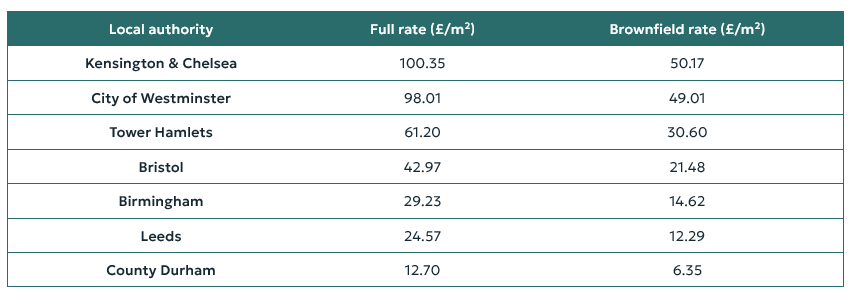
Illustrative rates from Schedule 3 of The Building Safety Levy (England) Regulations 2025.
When is it paid?
The BSL is a single bullet payment, due before the first completion or occupation certificate is issued. It is not paid in stages. Local authorities collect it, in a process broadly similar to the Community Infrastructure Levy (CIL):
- The developer submits abuilding control application on or after 1 October 2026.
- The developer files a BSLinformation return covering GIA, site classification and estimated liability.
- The building control authorityissues a Levy Liability Notice confirming the amount.
- A commencement notice beforeworks start formally activates the obligation.
- The developer pays the fulllevy before the first completion or occupation certificate, whichever isearlier.
- The completion certificate isissued once payment is received.
That last step is the one that matters most. If the levy is unpaid, the completion certificate is withheld, which can delay occupation, unit sales, refinancing and loan repayment. Disputes go to the collecting authority within 28 days of the notice, with a further appeal to the First-tier Tribunal.
What does it cost in practice?
Using the published rates, here is how the levy plays out on four hypothetical schemes. The same 30-home Westminster scheme is shown twice to illustrate the brownfield discount.
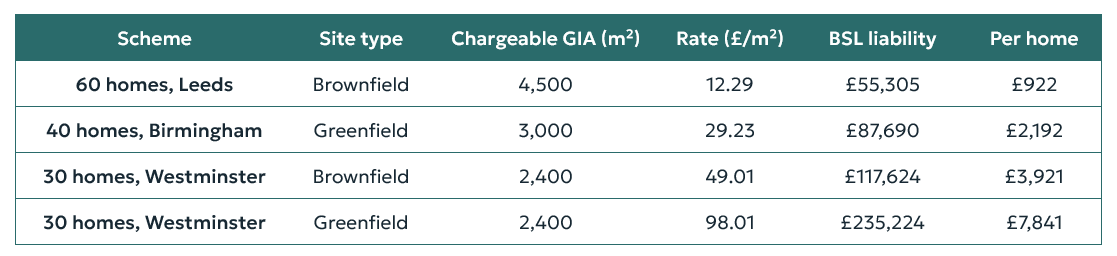
Two lessons stand out:
1. The PDL discount is worth a lot, so evidence it early: On the Westminster scheme, qualifying as brownfield saves £117,600. If the 75% PDL test can't be clearly shown, budget at the full rate.
2. Floorspace drives the bill, not unit count: Larger homes and generous communal areas cost more. On mixed-use or partly exempt schemes, commercial and exempt space must be carved out correctly, or the liability notice will be wrong.
What should developers do now?
The biggest risk is not the levy itself but leaving it out of the numbers, or adding it late. We recommend developers:
- Stress-test appraisals now, including at the full rate where a PDL discount is assumed.
- Build the levy into land negotiations early. With build costs rising and sales values sticky, the cost will often need to come off the land price.
- Check the rate for your local authority, as rates vary eight-fold across England.
- Gather PDL and exemption evidence before relying on any discount.
- Get GIA measured early on mixed-use and partially exempt schemes, so the chargeable area is clear from the start.
What lenders will look for
Development lenders will expect the levy to sit in the appraisal as a fixed project cost, alongside CIL and Section 106, not funded from contingency. Because it is one payment before completion, the facility needs to allow for a single drawdown at the right point in the programme.
Expect the levy to be tracked through the life of the loan:
- At underwriting: the building control application date,local rate, any PDL or exemption claim, and the levy line in the appraisal.
- During the build: the levy carried in each cost report, andany design change that adds residential floorspace recalculated.
- Before completion: the Levy Liability Notice checkedagainst the appraisal and funds in place to pay it.
- At completion: evidence that the levy has been paid.
Talk to us
If you have a scheme in the pipeline and want to understand how the levy affects your appraisal or funding, get in touch with our team.
This article is for information only and does not constitute legal or financial advice. Rates, guidance and legislation are subject to change. Please seek independent professional advice for your specific circumstances